
Applicable to OS V1.10
The ControlGear component is a device-class component used for a direct control of lighting with DALI commands. It represents any remote electronic device, such as lamps, ballasts, LED drivers, or transformers, that is used to control lighting equipment and complies with the DALI standard. The ControlGear component receives commands from a DALI controller or control system and broadcasts them to devices to regulate lighting functions such as dimming, switching, and monitoring.
The ControlGear component provides a unique addressability, allowing it to be controlled individually or as a part of a group, and a two-way communication, meaning it can send status information back to the DALI controller.
The component can be applied to any kind of the device, which complies with the DALI-2 standard. It supports a wide range of lighting technologies, including fluorescent, LED, and halogen lamps.
The ControlGear component must be located under the Network component in the DALI protocol.
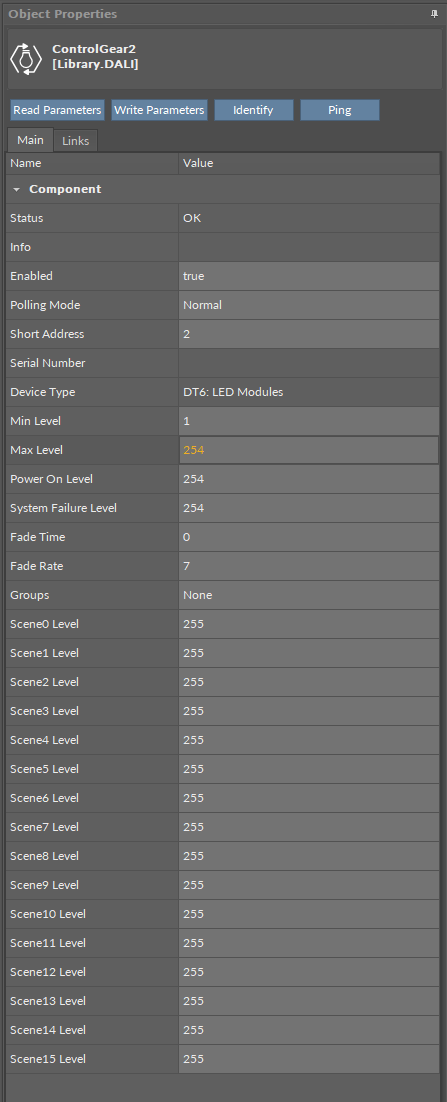
The ControlGear component has the following slots:
-
Status: indicates the current status of the component; if the component works properly, its status is OK. The component becomes Disabled, once the Enabled slot is in false or null. The component's status is Fault, once the component is not placed under Network. If there is no response from the addressed device, the component goes into the Down status.
-
Available information: Disabled, Fault, Down, OK.
-
-
Info: provides a detailed information about the Disabled and Fault statuses of the component;
-
Available information:
-
Incorrect placement - must be placed under Network (status Fault): occurs, when the InputDevice component is placed in a different location than under the Network component;
-
Incorrect configuration (status Fault): the short address is not defined;
-
Device disabled (status Disabled): the Enabled slot in the device is set to false;
-
Network disabled (status Disabled): the Enabled slot in the network is set to false;
-
The Info is a numerical slot, which displays a correlated text information:
-
|
Numerical value |
Displayed information |
|---|---|
|
0 |
No information displayed in the Info slot |
|
1 |
Incorrect placement - must be placed under Network |
|
2 |
Incorrect configuration |
|
3 |
Device disabled |
|
4 |
Network disabled |
-
Enabled: change of the slot's value enables or disables the component.
-
Available settings: true (enabled), false (disabled).
-
Note: If the Enabled slot is in false (meaning the component is disabled), the Status slot becomes Disabled.
-
Short Address: allows to enter a DALI short address of the controlled device;
Note
Short address in this slot is not written to the device itself, only in the application controller’s logic. The communication with the remote device will be sustained if the DALI short address in the ControlGear component is identical to the remote device’s. If these values differ, the ControlGear component will go into the Down status.
-
Serial Number: shows a serial number of a controlled device upon the Read Parameters action,
-
Device Type: shows which type is a controlled device:
-
Available information: Unknown (-1), FluorescentLamps (0), EmergencyLighting (1), DischargeLamps (2), LowVoltageHalogenLamps (3), IncandescentLamps (4), ConversionToDCVoltage (5), LEDModules (6), SwitchingFunction (7), ColourControl (8),
-
-
Min Level: allows to set a minimum output lighting level value,
-
Max Level: allows to set a maximum output lighting level value,
-
Power On Level: allows to set a lighting level value on a device’s power up,
-
System Failure Level: allows to set a lighting level value for a case of system failure (for example, a power loss),
-
Fade Time: allows to set a time for a lighting to increase/dim to a target level by a value from 0 to 15 representing times from instant change to 90.5 seconds:
|
4-bit value |
Fade time (sec) |
|---|---|
|
0 (default) |
Instant |
|
1 |
0.7 s |
|
2 |
1.0 s |
|
3 |
1.4 s |
|
4 |
2.0 s |
|
5 |
2.8 s |
|
6 |
4.0 s |
|
7 |
5.7 s |
|
8 |
8.0 s |
|
9 |
11.3 s |
|
10 |
16.0 s |
|
11 |
22.6 s |
|
12 |
32.0 s |
|
13 |
45.3 s |
|
14 |
64.0 s |
|
15 |
90.5 s |
-
Fade Rate: allows to set a speed rate a device can reach for a light to increase/dim to a target level by a value from 0 to 15 representing speed in steps per second from the fastest change to the slowest:
|
Value |
Fade rate (approx. steps/sec) |
|---|---|
|
1 |
358 steps/s (fastest) |
|
2 |
253 steps/s |
|
3 |
179 steps/s |
|
4 |
127 steps/s |
|
5 |
89.4 steps/s |
|
6 |
63.3 steps/s |
|
7 (default) |
44.7 steps/s |
|
8 |
31.6 steps/s |
|
9 |
22.4 steps/s |
|
10 |
15.8 steps/s |
|
11 |
11.2 steps/s |
|
12 |
7.9 steps/s |
|
13 |
5.6 steps/s |
|
14 |
4.0 steps/s |
|
15 |
2.8 steps/s (slowest) |
-
Groups: allows to assign a device to a specific group (or groups), which can represent a location, type of device, role, etc.,
-
Scene0-Scene15 Level: allow to set different lighting levels, which can reflect various lighting scenarios and be recalled instantly with a DALI command,
-
Available settings: 0-255, where 0-254 represent actual lighting levels and 255 value means that when a specific scene is recalled, a device should not change its lighting level (MASK value).
-
The ControlGear component has the following actions:
-
Read Parameters: reads all relevant parameters from a remote device and updates relevant slots,
-
Write Parameters: writes current parameter values to a remote device (lighting levels, fade time and rate values, group(s) assignment, scene levels),
-
Identify: sends the Identify DALI command to a remote device for identification,
-
Ping: sends a request to a remote device and waits for an answer (if there is no response from the requested device, the ControlGear component goes into the Down status).
ActionTrigger Extension
The ActionTrigger extension is designed to invoke any action that is available for the component. The extension triggers an action selected in the Action Name on the rising edge of the Action Trigger slot. If the action has parameters to set, the parameter is taken from a relevant slot automatically added to the extension (Analog Value/Binary Value/String Value).
It is possible to add more than one ActionTrigger extension to the component (for example, one for each action in the component).
The extension is added from the context menu of the component.
The ActionTrigger extension has the following slots:
-
Action Name: allows to select an action to invoke;
-
Action Trigger: triggers an action selected in the Action Name slot;
-
Action Analog Value/Action Binary Value/Action String Value: a slot added automatically to the extension if an action selected in the Action Name slot has any specific parameters to set (depending on the type of action and its parameters, the relevant type of value is matched).