
Note: Component applicable for the LP, Touch Point, and FP panels.
The Occupancy component is responsible for configuring occupancy settings in the panel.
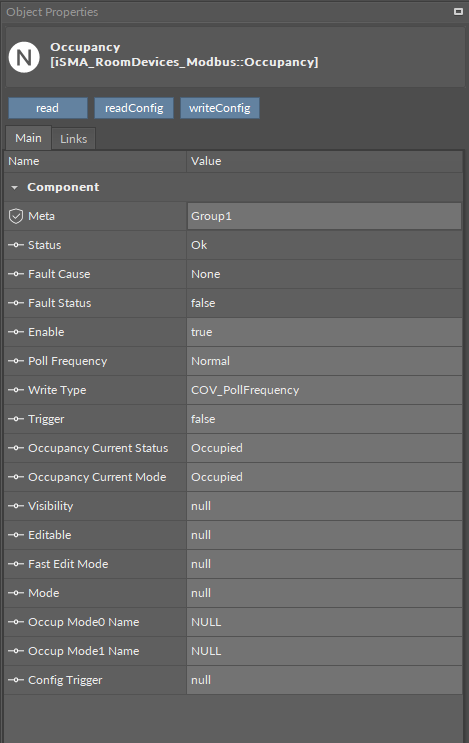
The Occupancy component has the following slots:
-
Status: shows the component’s status;
-
Fault Cause: shows the fault cause description;
-
Fault Status: informs about the point error status (true: point read/write error);
-
Enable: enables or disables the component (true: enabled, false: disabled);
-
Poll Frequency: allows to set the reading poll frequency (fast, normal, slow);
-
Write Type: defines a method of writing values (COV, COV_PollFrequency, PollFrequency, COV_LinkSet);
-
Trigger: allows to force sending values on rising edge;
-
Occupancy Current Status: sets the current status of occupancy (Unoccupied, Occupied, Standby, ForcedOccupied);
-
Occupancy Current Mode: sets the current mode of occupancy (Unoccupied, Occupied);
-
Visibility: allows to activate or deactivate the point on the display (only for the LP panel);
-
Editable: enables or disables editing of an occupancy in the panel;
-
Fast Edit Mode: enables a fast edit mode in the panel (only for the LP panel);
-
Mode: identifies a way of controlling the panel (LocalMode, BmsMode);
-
Occup Mode0 Name-Occup Mode1 Name: allows to set different occupancy mode names (up to 4, only ASCII characters; only for the LP panel);
-
Config Trigger: on rising edge sends configuration parameters to the device components (Editable, Mode).
The Occupancy component has the following actions:
-
Read: reads the panel’s occupancy values and updates the Occupancy Current Status and Occupancy Current Mode slots;
-
Read Config: reads configuration parameters from the panel (Editable, Mode);
-
Write Config: writes configuration parameters to the panel (Editable, Mode).